What cheap money built
One chart explains a lot about the startup boom. It explains how many companies got funded, and at what price. It explains much less about which ones were great. That difference matters more now than it did five years ago.
Ovick Alam · 10 November 2026
The chart
I started with a simple idea. Most of the startup success of the last fifteen years can be explained by one chart: the US federal funds rate.
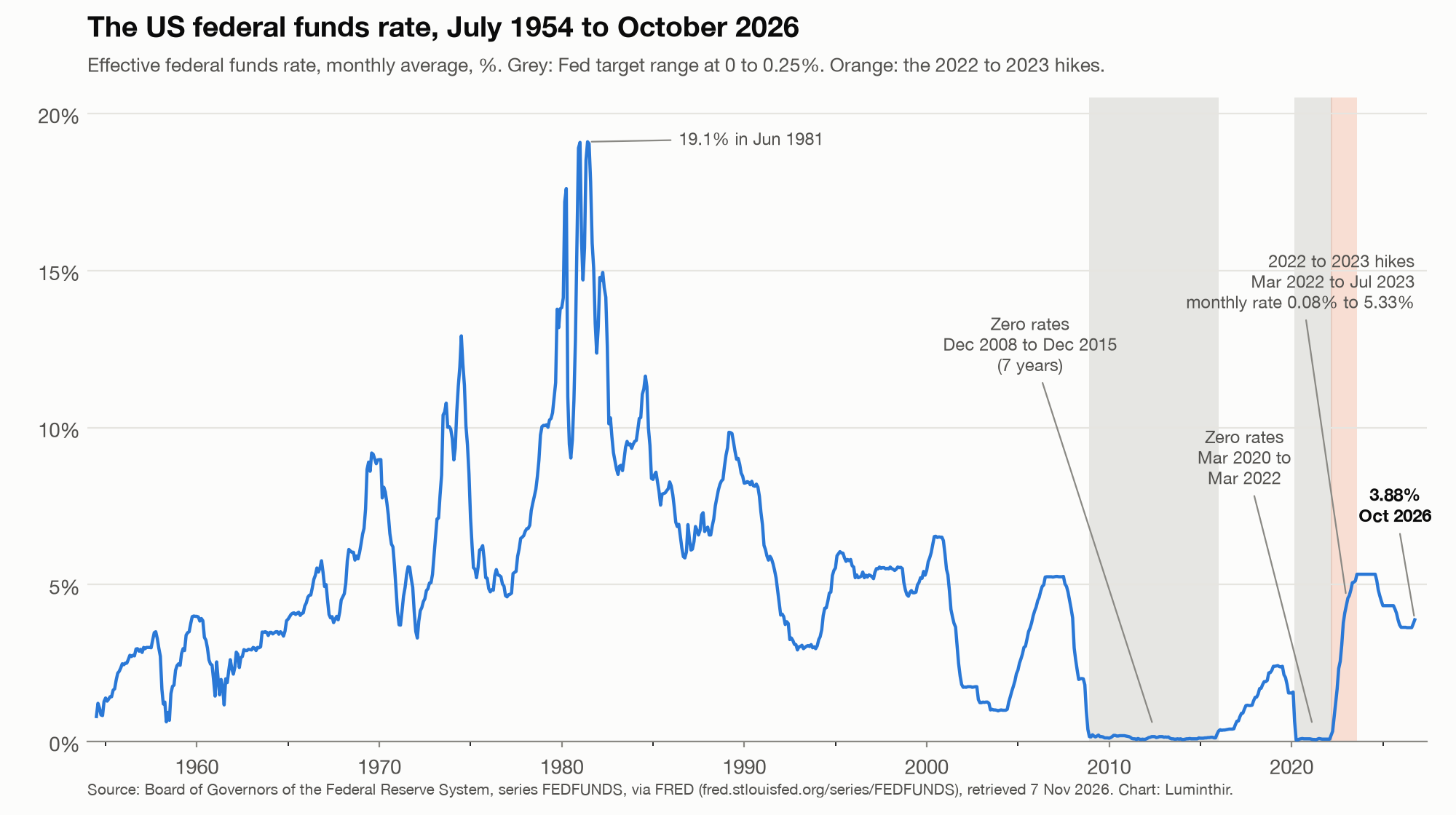
The rate has been recorded every month since July 1954. In 109 of those 868 months it sat below a quarter of a percent. That is about 9 years out of 72, in two stretches: December 2008 to December 2015, and March 2020 to March 2022. In more than half of all months, it was 4% or higher. Zero was the exception.
I tested the idea against the data before writing this. It holds for part of the story and breaks for the rest. Both parts are useful to an owner.
What cheap money did
It decided how many startups got funded, and what they were priced at.
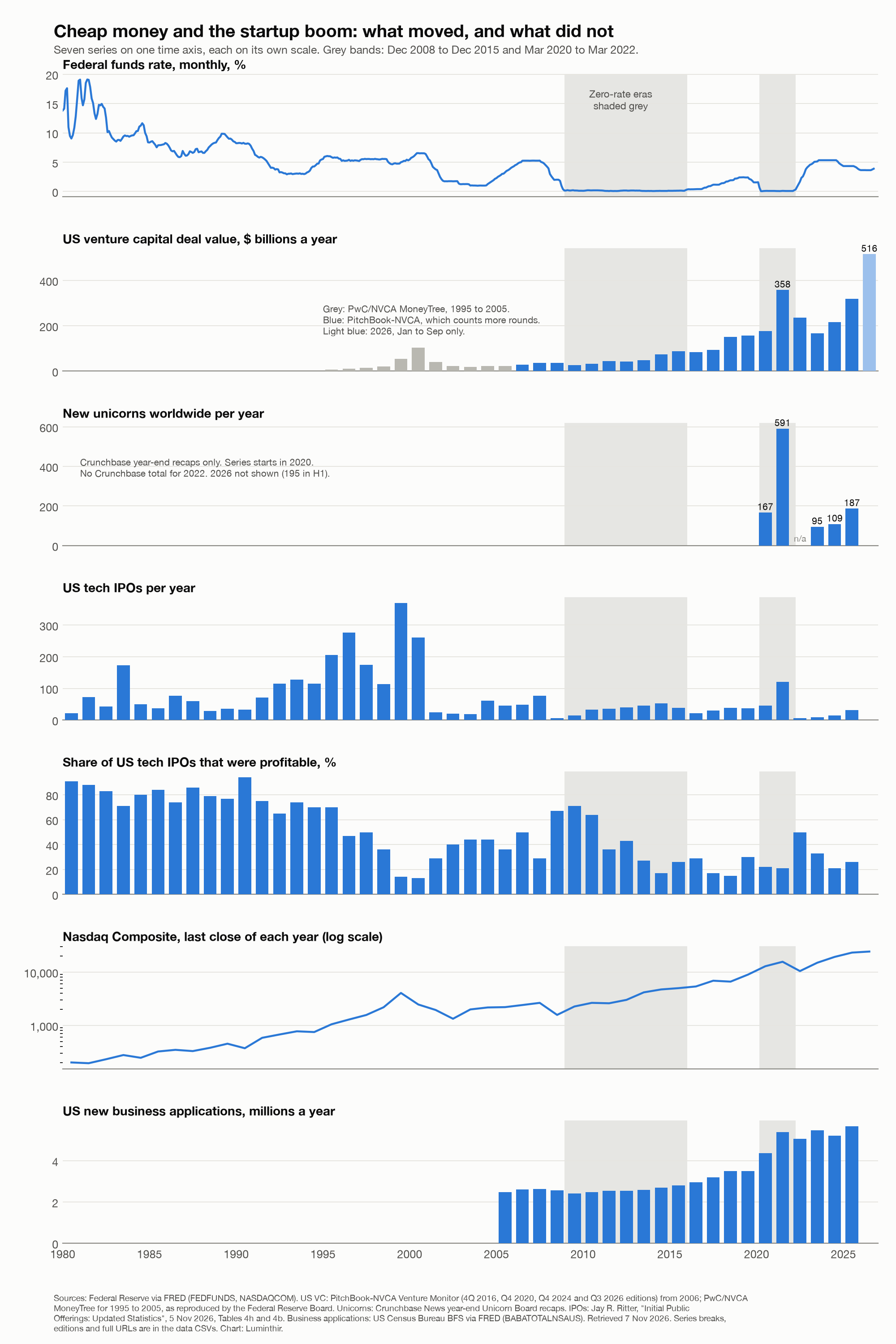
US venture money was $358 billion in 2021. Two years later, after the Fed took its rate from near zero to above 5%, it was $166 billion, down 54% (PitchBook-NVCA). New unicorns, private companies valued at a billion dollars or more, fell from 591 worldwide in 2021 to 95 in 2023 (Crunchbase's year end counts). US tech companies going public fell from 121 in 2021 to 6 in 2022 (Jay Ritter, University of Florida).
Paper value moved far more than cash. In 2021, 220 US venture backed companies were sold or listed at $500 million or more. In the three years after, only 114 were (PitchBook-NVCA, Q4 2024).
The quality of what went public tells the same story. From 1980 to 1995, between 65% and 94% of the US tech companies that went public each year were profitable. In 2021 it was 21% (Ritter). The companies that listed by merging with a SPAC in 2021 lost about 64% on average in their first year (Ritter).
This isn't only a pattern in a chart. Yueran Ma and Kaspar Zimmermann studied US monetary policy surprises from 1969 to 2007. A one point tightening was followed by about a 25% fall in venture investment over the next one to three years (NBER Working Paper 31698, 2023). Rates move venture money.
They also change what gets tried. Ramana Nanda and Matthew Rhodes-Kropf found that startups first funded in hot markets fail more often, but the ones that reach an IPO are worth more and hold more patents (Journal of Financial Economics). Cheap money funds bolder bets. More of them fail, and a few win bigger.
What it didn't do
It didn't decide whether great companies got built.
Microsoft was founded in April 1975, when the Fed's rate was 5.5%. Apple in April 1976, at 4.8%. Amazon in July 1994, at 4.3%. Google in September 1998, at 5.5% (founding months as commonly reported; rates from FRED). The fair other side: Uber, Stripe and OpenAI were founded in zero rate months. Great companies get started in both.
People kept starting businesses whatever the rate. Americans filed 2.4 to 2.8 million new business applications a year during the first zero rate era. In 2025, with rates above 4%, they filed a record 5.67 million (US Census Bureau). Most of those never hire anyone, but the direction is clear.
And technology waves can beat the cost of money. The dot com boom happened with the Fed's rate between 5% and 6.5%: 370 US tech IPOs in 1999 alone (Ritter). In the first nine months of 2026, US venture deal value reached $516 billion, already a record year, with the rate near 4%. About 83% of it went to AI (PitchBook-NVCA, Q3 2026). That money is concentrated in a few very large rounds.
So the version the evidence supports is smaller than the one I started with. Cheap money decided how many startups got funded and what they were priced at. Whether the best of them were great had more to do with the technology of the moment and the people building it.
What changed: the buyer borrows too
This is the part an owner can use.
A price for a business is what a buyer can pay and still earn more than their own cost of money. That cost isn't the Fed's rate. In 2021, when the Fed's rate was near zero, a solid US company (rated Baa by Moody's) paid about 3.4% on its bonds. In 2025 it paid about 6%. In October 2026, about 6.6% (FRED).
The same maths applies to every taka of profit you promise for later. At 0%, Tk 100 of profit ten years from now is worth Tk 100 today. At 5% it's worth Tk 61. At 10% it's worth Tk 39 (illustrative). When money costs something, near cash is most of the value, and a story about year ten is worth much less.
That is why the language of the zero rate years, valuation, growth and burn, now reads differently. A buyer who pays 6% to borrow pays for cash they can see.
Where rates are now
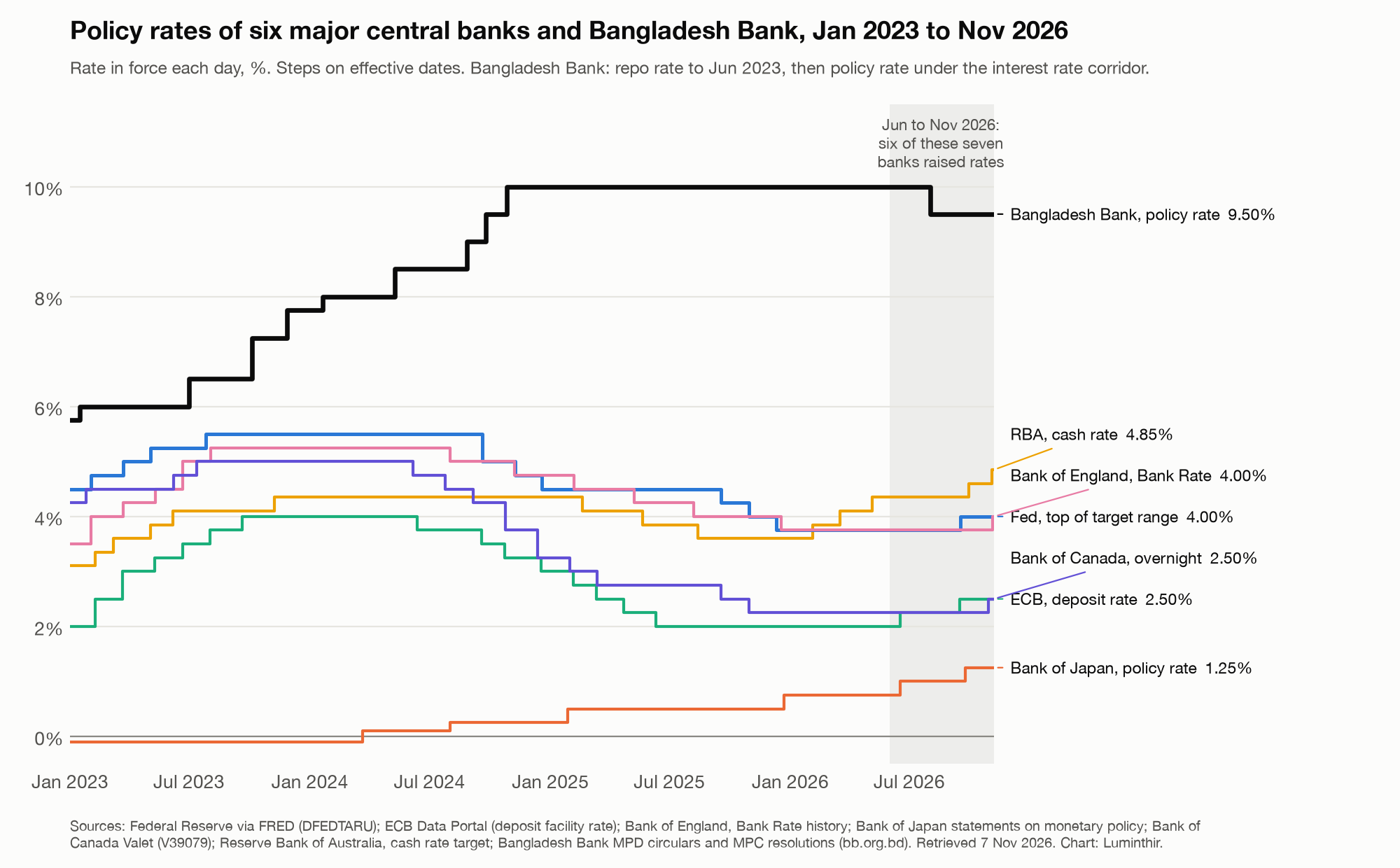
The world hasn't gone back to zero. Between June and November 2026, six of the seven central banks in this chart raised rates: the Fed (3.75% to 4.00%), the ECB (2.50%), the Bank of England (4.00%), the Bank of Japan (1.25%), the Bank of Canada (2.50%) and the Reserve Bank of Australia (4.85%). India's central bank raised its repo rate to 5.5% in October. When the Fed held in October, two of its twelve voters wanted another rise. Nobody knows where rates go next. The safe plan is a business that doesn't need them to fall.
Bangladesh didn't get zero
When the Fed was at zero in 2020, Bangladesh Bank's repo rate was 4.75%. It was 5.75% in January 2023, reached 10% in October 2024, and was cut to 9.5% in August 2026. Owners here have not had cheap money.
Cheap money reached Bangladesh only as foreign venture money, and only for a few companies. Bangladeshi startups raised about $415 million in 2021, most of it one round: bKash's $250 million from SoftBank. In 2025 they raised $124 million, about 89% of it in one deal. In the first half of 2026, $6 million (LightCastle Partners, disclosed deals).
Most businesses here grow on bank credit, supplier credit and their own profit. In October to December 2025 alone, banks lent Tk 70,170 crore to cottage, micro, small and medium enterprises (Bangladesh Bank data). Loans are repaid and lent again, so it isn't a like for like comparison with startup equity. It still shows where growth money here lives.
At 10%, the business that wins is the one that pays its way. Many Bangladeshi owners already run that business. The West is being pushed towards the conditions they have always worked in.
The companies that win when money costs something
Four qualities, each with a test you can run on your own business this month.
- It pays its own way early. Growth comes from margin and repeat customers before it comes from new capital. Test: how fast could you grow next year on this year's profit alone?
- The cash is real. Profit turns into cash quickly. Customers pay on time or upfront, and little money sits in stock and receivables. Test: how many days pass between paying a supplier and collecting from a customer?
- It can set its price. Gross margin leaves room to absorb money that costs 4% to 10%. Test: what happens to your profit if you pay 3 points more for credit?
- Customers come back, and the owner plans to stay. Demand repeats without being paid for each time, and the owner builds to hold the business, not to sell it on. Test: what share of this month's sales came from customers who bought before?
When venture money is right
Venture money is still the right tool for the few building something that needs years of capital before it earns, such as the AI models of 2026. If that is your business, the chart above says the money is there. For everyone else, the buyer's maths has changed.
Cheap money paid for stories. Today's money pays for cash.
Numbers are illustrative where marked. Not legal or investment advice. Sources and data: listed below, with every series and its link.
Sources
- Federal funds rate (FEDFUNDS), Fed target range (DFEDTARU), Moody's Baa corporate bond yield (BAA), Nasdaq Composite (NASDAQCOM) and US business applications (BABATOTALNSAUS): Federal Reserve and US Census Bureau, via FRED, retrieved 7 Nov 2026.
- PitchBook-NVCA Venture Monitor, Q3 2026.
- Crunchbase News, Unicorn Board year-end recaps, Feb 2022 and Feb 2024.
- Jay R. Ritter, "Initial Public Offerings: Updated Statistics", University of Florida, 5 Nov 2026.
- Yueran Ma and Kaspar Zimmermann, "Monetary Policy and Innovation", NBER Working Paper 31698, 2023.
- Ramana Nanda and Matthew Rhodes-Kropf, "Investment Cycles and Startup Innovation", Journal of Financial Economics (HBS Working Paper 12-032).
- PitchBook-NVCA Venture Monitor, Q4 2024 (exits of $500 million or more).
- FOMC statements of 16 Sep and 28 Oct 2026. Reserve Bank of India, press release of 7 Oct 2026.
- ECB, Bank of England, Bank of Japan, Bank of Canada, Reserve Bank of Australia and Bangladesh Bank, policy rate decisions, Jan 2023 to Nov 2026.
- LightCastle Partners, Bangladesh startup investment reports (2022 report; 2025 via The Financial Express, 3 Mar 2026; H1 2026 via Dhaka Tribune, 28 Jul 2026). Bangladesh Bank lending data via The Financial Express, 2 Aug 2026.